
Three-program design
| Program | Purpose | Program ID |
|---|---|---|
| Liquidity | Core layer: token vaults, exchange prices, utilisation, rates | jupeiUmn818Jg1ekPURTpr4mFo29p46vygyykFJ3wZC |
| Lending | Earn: deposit assets, mint jlTokens, supply into Liquidity | jup3YeL8QhtSx1e253b2FDvsMNC87fDrgQZivbrndc9 |
| Vaults | Borrow: collateralize, borrow, liquidate, supply/borrow via Liquidity | jupr81YtYssSyPt8jbnGuiWon5f6x9TcDEFxYe3Bdzi |
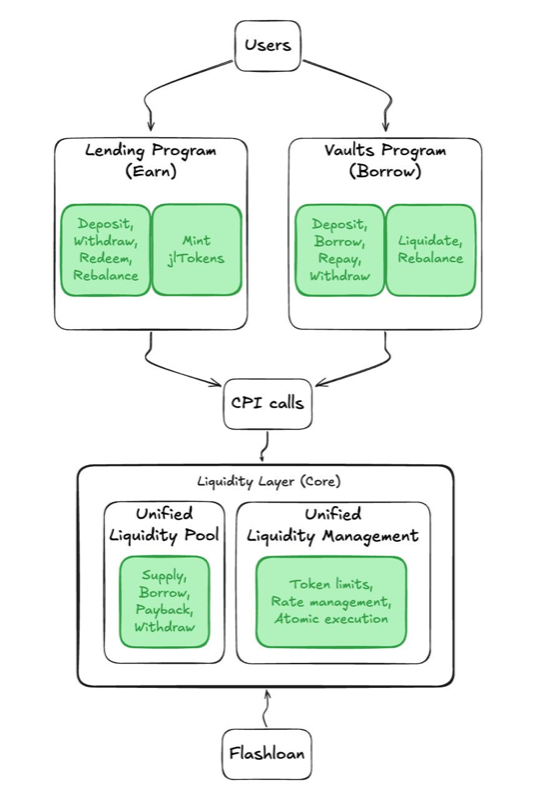
Liquidity (core layer)
Liquidity serves as the foundational layer, owning all token vaults and custodying every deposited and borrowed asset. User-facing protocols never interact with tokens directly; they always make CPI calls into Liquidity to handle supply and borrow operations.Key state
| Account | Purpose |
|---|---|
| TokenReserve | Per-mint: vault, exchange prices, totals, utilisation, rate config |
| UserSupplyPosition | Per (mint, protocol): supply amount, withdrawal limit, status |
| UserBorrowPosition | Per (mint, protocol): borrow amount, debt ceiling, status |
| RateModel | Interest rate curve driven by utilisation |
Protocol registration
Protocols (Lending, Vaults) must be registered viainit_new_protocol(supply_mint, borrow_mint, protocol):
- Lending: supply mint only (Earn supplies into Liquidity, no borrow)
- Vaults: supply mint (collateral) and borrow mint (debt)
Operate flow
- pre_operate(mint): marks the interacting protocol and timestamp on
TokenReserve - Caller moves tokens into the Liquidity vault (via SPL transfer)
- operate(supply_amount, borrow_amount, withdraw_to, borrow_to, transfer_type): updates exchange prices, UserSupplyPosition/UserBorrowPosition, TokenReserve totals, and performs transfers
operate, so interest accrues on every interaction.
Lending (Earn)
Earn lets users deposit assets and receive jlTokens (shares). Deposits are supplied into Liquidity, and jlTokens represent a share of the pool with accrued interest and rewards.Key state
| Account | Purpose |
|---|---|
| LendingAdmin | Factory: authority, liquidity_program, rebalancer, auths |
| Lending | Per-mint pool: mint, jl_token_mint, token_reserves_liquidity, supply_position_on_liquidity, exchange prices |
User flow
- Deposit: User transfers tokens → Lending CPIs Liquidity
pre_operate+operate(supply)→ mints jlTokens - Withdraw/Redeem: Burns jlTokens → CPIs Liquidity
operate(withdraw)→ user receives underlying
UserSupplyPosition on Liquidity for that mint. The rewards rate model (separate program) adjusts the jlToken exchange price to include rewards on top of base yield.
CPI summary
| Caller | Signer | Supply position | Borrow position |
|---|---|---|---|
| Lending | Lending PDA | Lending PDA (1 per mint) | None |
Vaults (Borrow)
Borrow vaults are collateralized lending markets. Each vault has a supply token (collateral) and a borrow token (debt). Users deposit collateral, borrow against it, and can be liquidated if collateral falls below the liquidation threshold. Positions are represented as NFTs.Key state
| Account | Purpose |
|---|---|
| VaultConfig | Params: supply_token, borrow_token, oracle, collateral_factor, liquidation_threshold, rebalancer |
| VaultState | Runtime: total_supply, total_borrow, topmost_tick, absorbed debt/collateral |
| Position | User position: vault_id, tick, supply_amount, debt, liquidation status |
| Branch | Liquidation structure: minima tick, debt factor, status |
| Tick | Price-ratio ticks for collateralization |
Tick-based pricing
Vaults use tick-based pricing: collateralization is computed from a price-ratio tick rather than a simple LTV. Collateral factor is derived from tick ratio. Branches track liquidation state and merge positions when liquidated.User flow
- init_position: create Position + position mint NFT
- operate: deposit/withdraw collateral, borrow/repay debt
- liquidate: liquidate undercollateralized positions
- rebalance: rebalancer supplies/borrows on Liquidity to match vault demand
UserSupplyPosition (collateral) and a UserBorrowPosition (debt) on Liquidity. The Oracle program provides prices for collateral valuation and liquidation checks.
CPI summary
| Caller | Signer | Supply position | Borrow position |
|---|---|---|---|
| Vaults | VaultConfig PDA | VaultConfig PDA | VaultConfig PDA |
Shared data flow
Both Lending and Vaults share the same Liquidity layer:| Shared account | Used by | Role |
|---|---|---|
| TokenReserve | Both | Aggregated supply/borrow per mint |
| UserSupplyPosition | Both | Per-protocol supply |
| UserBorrowPosition | Vaults | Per-protocol borrow |
| Vault (ATA) | Both | Liquidity holds all tokens |
| RateModel | Both | Interest rate parameters |
Deposit (Earn)
Borrow (Vaults)
Dependency graph
| Program | Depends on |
|---|---|
| Lending | Liquidity (CPI), Lending Rewards Rate Model |
| Vaults | Liquidity (CPI), Oracle |
| Liquidity | Standalone |
| Oracle | Standalone |
Related docs
- Unifying Liquidity: Liquidity layer overview and key features
- Earn Overview: deposit/withdraw mechanics
- Borrow Overview: vaults, positions, liquidations
- Liquidity analytics: market data, utilisation, exchange prices
- Oracles: price feeds for vaults
- Program addresses: program IDs and IDL